
Coffee & Tea with Janis Quinlan and Cindy Bills
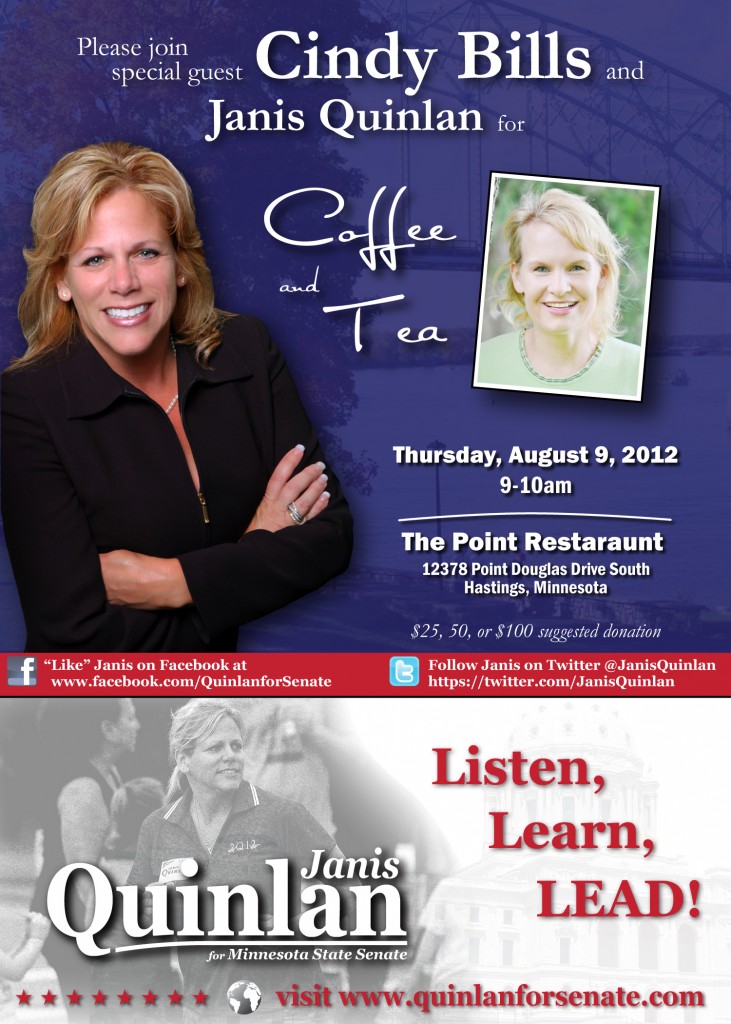
Join State Senate Candidate Janis Quinlan and U.S. Senate Candidate Kurt Bills wife, Cindy, for a morning coffee and tea event at The Point Restaurant in Hastings, Minnesota.
While you enjoy your morning beverage and a variety of rolls and pastries, Janis will be talking about her campaign while Cindy will be discussing the Bills campaign.
This is a great opportunity to get to know Janis Quinlan and also to hear from Cindy on what is happening with the U.S. Senate race. You will also have the opportunity to ask them questions!
RSVP’s are appreciated to [email protected]
—
Janis Quinlan for Senate Website
www.QuinlanforSenate.com
Find Janis on Facebook
www.Facebook.com/QuinlanforSenate
Follow Janis on Twitter
www.Twitter.com/JanisQuinlan
Representing Republicans at the Washington County Fair!

For the first time, Washington County Republicans will be hosting a booth to represent all of the Republicans in Washington County at the Washington County Fair in August 2012. We are working with the local Senate and House Districts, along with local candidates to coordinate volunteers to help at the booth. Candidates will be stopping by the booth to answer questions throughout the fair. Times and dates will posted soon. We will be offering games, contests, polls and giveaways for those stopping by the booth to enjoy. Let’s make this year fun and informative!
The Washington County Fair is held Wednesday, August 1st – Sunday, August 5th. The booth will be open 8:00am-10:00pm on every day of the fair. We are asking volunteers to sign up for 1-2 hour shifts during these times. We are required to have someone at our booth every hour the fair is open. With the country in economic turmoil and the recent passage of Obamacare, we need to show the people that there is an alternative. Join us and support your local candidates, representatives and fellow Republicans in Washington County!
To volunteer, please visit our website www.wcrmn.com and sign up on the homepage or under the “Volunteer” tab.
Washington County Republicans Meeting 6/09: Twila Brase on Health Care
GUEST SPEAKER: Twila Brase – Citizen’s Council on Health Care

Twila Brase is president and co-founder of the Citizens’ Council on Health Care (CCHC), a freedom-focused, patient-centered national health care organization based in St. Paul, Minnesota.
In August 2009, Modern Healthcare magazine named her as #75 on the “100 Most Powerful People in Healthcare” list. In May 2010, the Star Tribune profiled her on the front page: “Twila Brase: Health care power or health care pain?” In 2000, the Minnesota Physician magazine selected her as one of “Minnesota’s 100 Most Influential Health Care Leaders.” Ms. Brase provides daily radio commentary through the “Health Freedom Minute” (AM1280 – The Patriot), provides testimony at the legislature, meets with members of Congress, and speaks around the country.
The Council’s efforts have stopped government-issued treatment directives, led to a veto of a “Baby DNA Warehouse” bill, added informed consent requirements for access to patient data, defeated a
proposed Health Insurance Exchange, defeated an attempt to repeal genetic privacy and informed consent rights regarding newborn DNA, and led to lawsuits in Minnesota and Texas against the
illegal storage, use, and dissemination of newborn DNA.
Cost:
$20 for non-members, $15 for members (includes breakfast)
** Everyone in attendance will be entered into a drawing for a fabulous prize! **
To ensure we have an accurate breakfast count for the Inn, please RSVP by Thursday, June 7th. If you plans change, please let us know by Friday the 8th to avoid a charge for the breakfast prepared for your reservation. You can RSVP via Evite, or call Karen Markowitz: 651-275-0543.